The Price of the Persecution Cycle: Deconstructing Scourge Comics’ “Ecclesia: The Calling”
16 Dec 2025
Spotlight


Recent Posts
We Are Moving
14 Feb 2026
Toontopia Festival Returns for Second Edition as Nigeria’s Animation Ecosystem Expands
14 May 2026
Cultural Blind Spot and the Missing Category: Why AMVCA Must Recognise African Animation
13 May 2026
Cairo’s Animatex 2026: A 90-Year Legacy Meets the Cutting Edge of Global Animation
18 Feb 2026
Introducing The10: A Curated List of Women Shaping Africa’s Comic and Animation Future
16 Feb 2026
An Overview
Ecclesia: The Calling is a dark, supernatural horror comic from Scourge Comics that blends religious lore with modern-day demonic possession and cosmic warfare. The narrative establishes a rich, if dense, historical backdrop: the First Church, called Ecclesia, was established in A.D. 53, leading to brutal persecution under Emperor Nero. The core concept is the "Persecution Cycle," which arises every half a millennium and calls forth a generation of descendants to oppose it. The current cycle, triggered prematurely by an “unusual Nexus” after 1,968 years, focuses on the “premature calling of the young descendants”. The comic plunges the reader immediately into the horrifying consequences of this event through the tormented youth, Marcus Komolafe.
A Detailed Summary
The story begins with a monologue on the nature of Time and the scarring or moulding power of historical "events”. This abstract introduction is immediately juxtaposed with a mundane, modern-day scene: a group of young friends playing 'Hide and Seek' in a playground (Page 5).
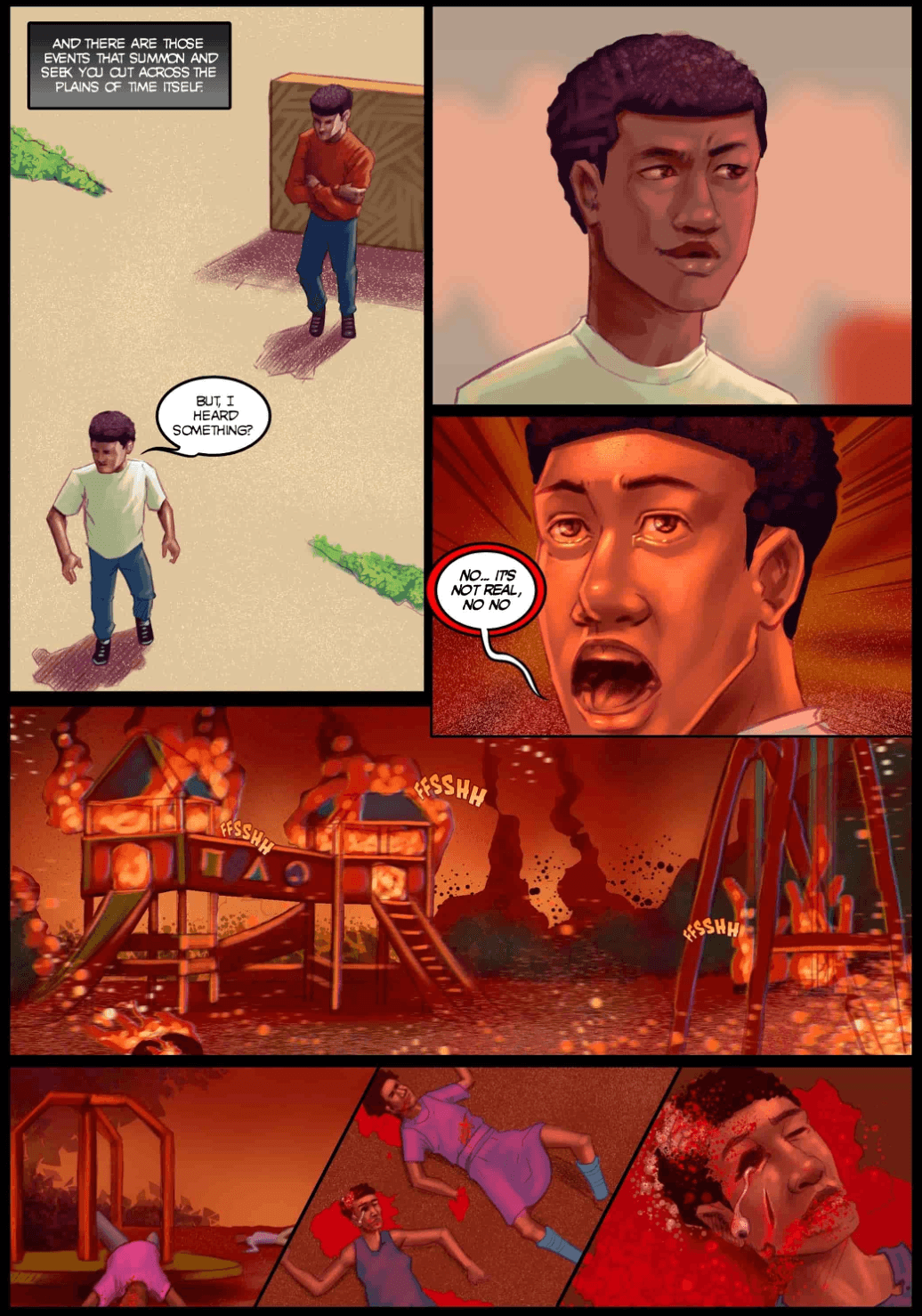
The Premonition (Pages 5–11)
The protagonist, Marcus, hears a strange calling of “ECCLESIA!”. A mundane argument with his friend, Francis, over a hiding spot is violently interrupted by a sudden, visceral vision. The colourful playground transforms into a hellish landscape of fire and blood (Page 7). Marcus sees his friends and Francis brutally slaughtered. This is quickly followed by a vision of a demonic figure torturing Francis, accusing Marcus of forgetting his destiny and forging. Marcus, powerless, screams in terror as his vision concludes with a "THWEEP" and "THUD”.
The Aftermath and Seek for Help (Pages 12–17)
Marcus awakens from the nightmare, distressed and convinced that “He killed Francis”. His parents, the Komolafes, reassure him that Francis is "fine and alright" and administer tablets (Pages 12–13). His mother notes the nightmares are now "frequent... and more serious" and states they are going to see “The Father tomorrow evening”. The family drives to a bleak, seemingly desolate location. Marcus’s father, Mr. Komolafe, explains that "The Father" has a reputation for "healing the greatest afflictions and casting out the toughest demons”. They are greeted by Father Michael, who informs them that Father Abraham is expecting them.
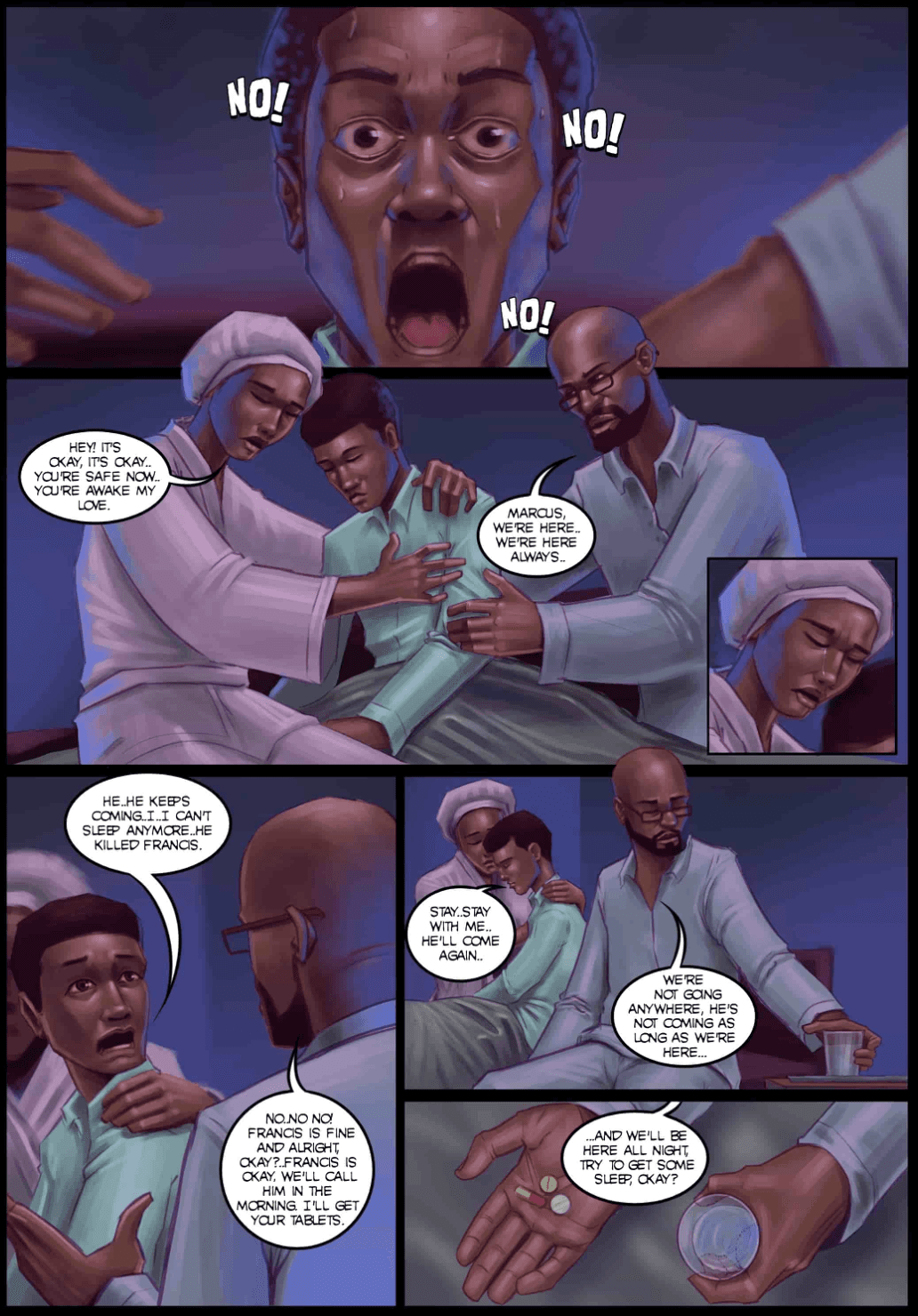
The Exorcism and the Nexus Break (Pages 18–28)
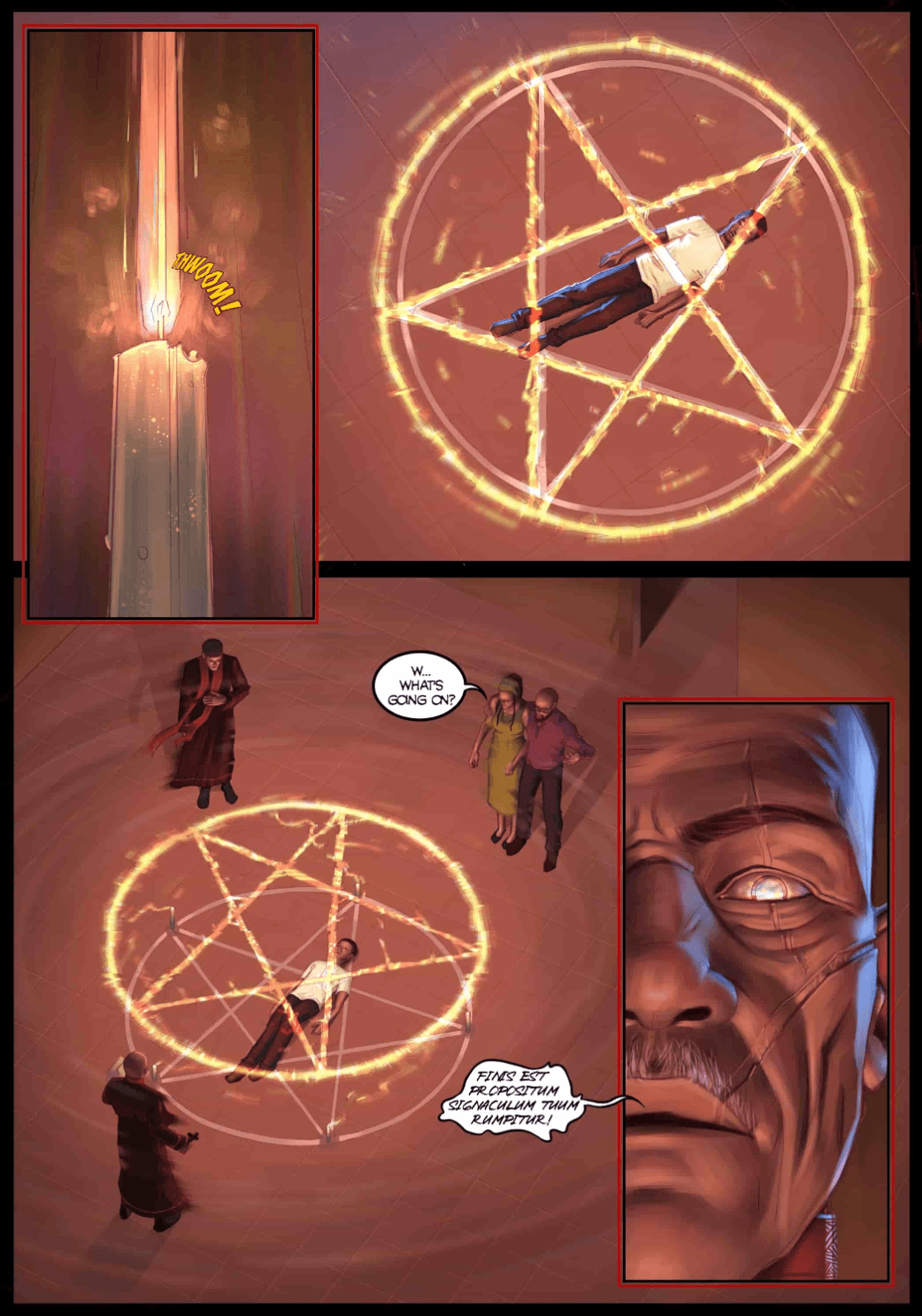
Father Abraham, a scarred man with a cloudy eye, meets the Komolafes in a room featuring a pentagram ritual circle drawn on the floor (Page 18). He reveals that Marcus’s body is “host to the Blackthorn, a Duke from the bowels and dungeons of Hell itself”. An exorcism commences, using the “Blackthorn Transitum,” ancient Catholic texts for the safe passage of the demon from its host. As Father Abraham recites Latin, he instructs Marcus to repeat the command: “SIGNACULUM TUUM RUMPITUR, SOLUS I. PRIMUS ECCLESIA HOC INVOCAT!” (Pages 21–23).
This act triggers a violent global reaction. The seal is "broken," and the “ECCLESIA POWERHOLDS ARE AWAKE!”. In a monastery in France (9:01 PM), a group of monks who are "Guardians of the Ecclesia Powerholds" are horrified. They realise "Someone is forcefully influencing a Nexus!…toying with powers beyond comprehension!”. The Blackthorn is "almost free". The monks attempt a ritual to "repulse the attacks and deceits of the devil", but the freed Blackthorn, now appearing as a massive, horned, fiery demon (Pages 26–27), brutally slaughters them in a scene of extreme gore, indicating "The Cleansing Begins" (Page 28).
Our Critique
Ecclesia: The Calling establishes itself as a bold, visceral entry into the supernatural horror genre, but its ambition occasionally outstrips its clarity. Its strenghts lies in its high-concept historical lore, its artwork, and atmospheric contrast.
Its conceptual historical lore creates the premise of an ongoing "Persecution Cycle" linking the First Church in A.D. 53 to a modern-day demonic nexus is genuinely intriguing and provides a solid foundation for a long-form series. The inclusion of the mysterious, scarred Father Abraham and the "Ecclesia Powerholds" adds a promising layer of mystery and mythology.
The illustration style is a major strength, especially in the horror sequences. The transition from the peaceful playground to a fiery, blood-soaked massacre (Page 7) is a terrifying, effective shock. The close-ups of Marcus screaming (Pages 7–11) and the grotesque, bloody slaughter of the French monks (Pages 26–28) are powerfully rendered, setting a definitively dark and mature tone for the comic.
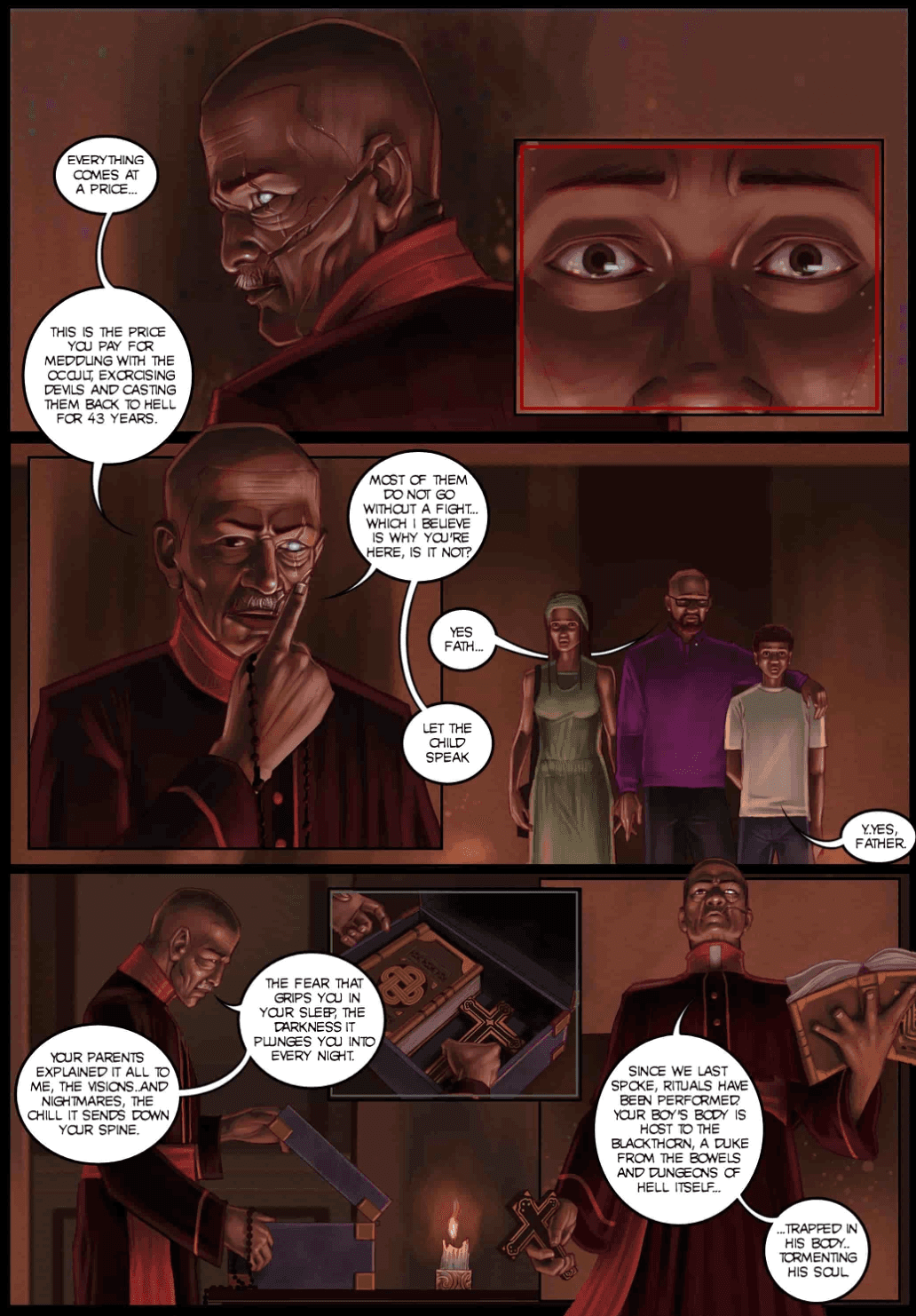
Employing atmospheric contrast, the opening juxtaposes the abstract nature of Time with an immediate, specific traumatic event, which efficiently hooks the reader. The dark, candle-lit setting of Father Abraham’s initial meeting contrasts starkly with the sudden worldwide disturbance, highlighting the gravity of the exorcism.
Nothing is ever perfect, and same can be said of this horror-thriller. The comic book can work on its overall pacing, especially for clarity in the opening. There were overly technical dialogues and the main character seem not to have any agency (perhaps a story for subsequent issues).
The initial abstract monologue runs for too long (Pages 5–6), delaying the introduction of Marcus and the core conflict. The synopsis already provides the historical context, so the opening pages could have been used to establish Marcus’s world and trauma more quickly, rather than philosophising on “Time” and “Events”.
Additionally, while the Latin incantations add authenticity, the exposition on the "Blackthorn Transitum" and the nature of the demon ("Duke from the bowels and dungeons of Hell itself" 40) is overly verbose. Similarly, the dialogue in France, discussing the demon's "500 years of... bondage" and a "forcefully influencing a Nexus", is dense and relies heavily on jargon without sufficient visual grounding, making the sudden shift in global scale feel rushed.
The possessed host, Marcus, is introduced as a character suffering greatly, yet his role in the climax is merely to repeat words dictated by Father Abraham. To elevate the narrative, the script should imply or demonstrate that Marcus is more than just a host—perhaps his lineage as a descendant of the Ecclesia grants him some intrinsic, active power in the ritual, rather than making him a passive participant in his own salvation.
To conclude, Ecclesia: The Calling presents a spectacular and gory vision of spiritual warfare with an exciting mythological underpinning. While the heavy exposition detracts slightly from the flow, the strength of the horror visuals and the potent central conflict make it a strong entry point into a series that promises high-stakes supernatural drama.
…………………………………………………………….
…………………………………………………………….
AI Use at TheACE
TheACE uses artificial intelligence tools to support research, drafting and analysis across Africa’s creative industries. All content is verified, edited and approved by our human editorial team to ensure accuracy, clarity and responsible storytelling. AI assists our work; it does not replace human judgment.