Canvas of the Macabre: Theology, Crime, and Visual Discipline in Hounds and Jackals
2 Feb 2026
Spotlight
Recent Posts
We Are Moving
14 Feb 2026
Toontopia Festival Returns for Second Edition as Nigeria’s Animation Ecosystem Expands
14 May 2026
Cultural Blind Spot and the Missing Category: Why AMVCA Must Recognise African Animation
13 May 2026
Cairo’s Animatex 2026: A 90-Year Legacy Meets the Cutting Edge of Global Animation
18 Feb 2026
Introducing The10: A Curated List of Women Shaping Africa’s Comic and Animation Future
16 Feb 2026
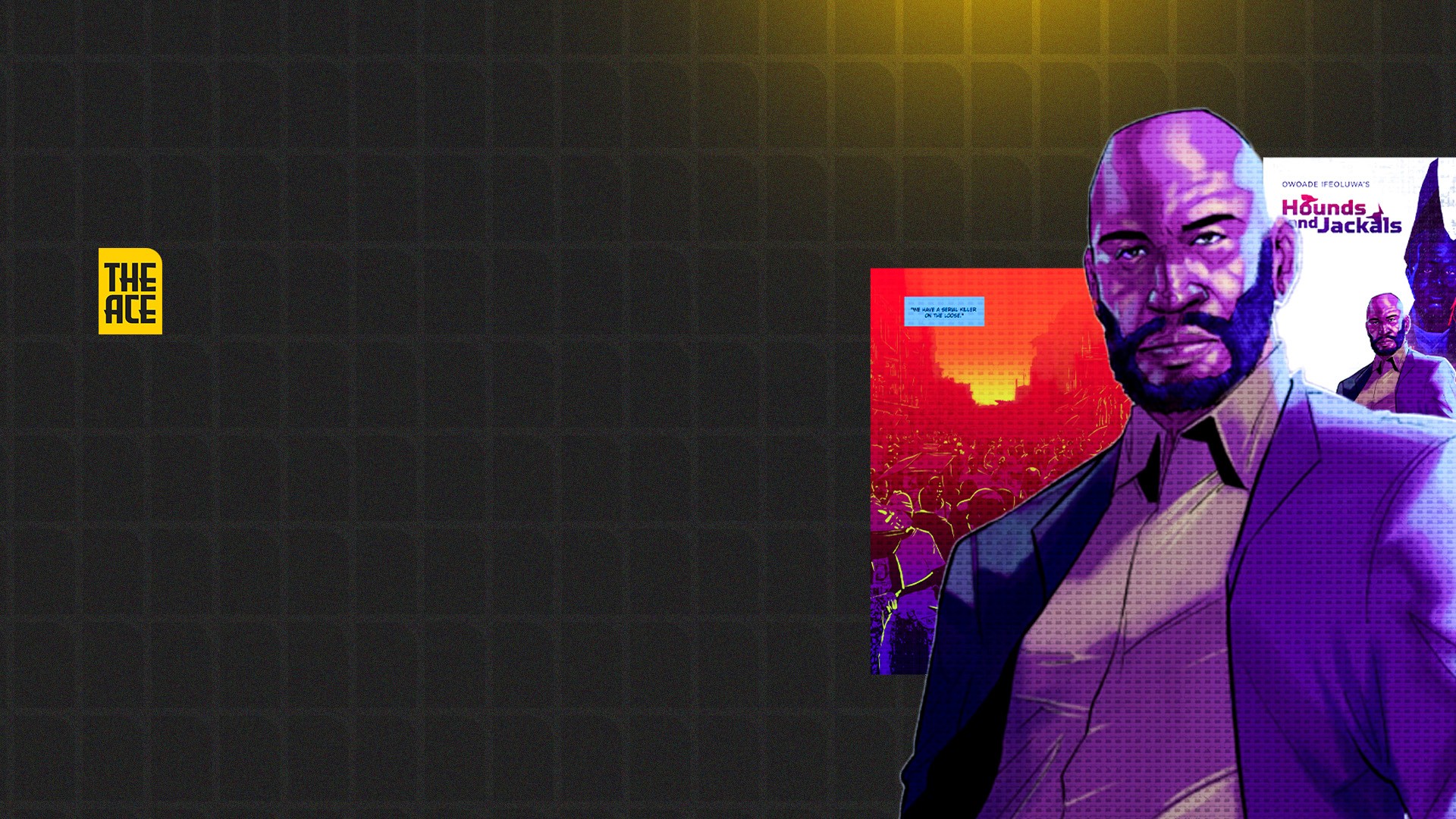
In the landscape of contemporary African sequential art, few works attempt to bridge the gap between gritty procedural noir and high-concept theological symbolism with as much ambition as Owoade Ifeoluwa’s Hounds and Jackals. Set against the backdrop of Abuja, the comic presents a chilling look at a killer who treats human life not merely as a target, but as a medium for artistic recreation.
The Narrative Arc: A Summary
The story opens at a harrowing crime scene on Ibrahim Chollom Street, where Detective Wande and the legendary Special Investigator Reuben Abiola discover the bodies of Mr Taiwo Yusuf and his wife, Salma. While the local police are tempted to dismiss the event as a standard robbery gone wrong, Abiola identifies a systematic, theatrical cruelty.
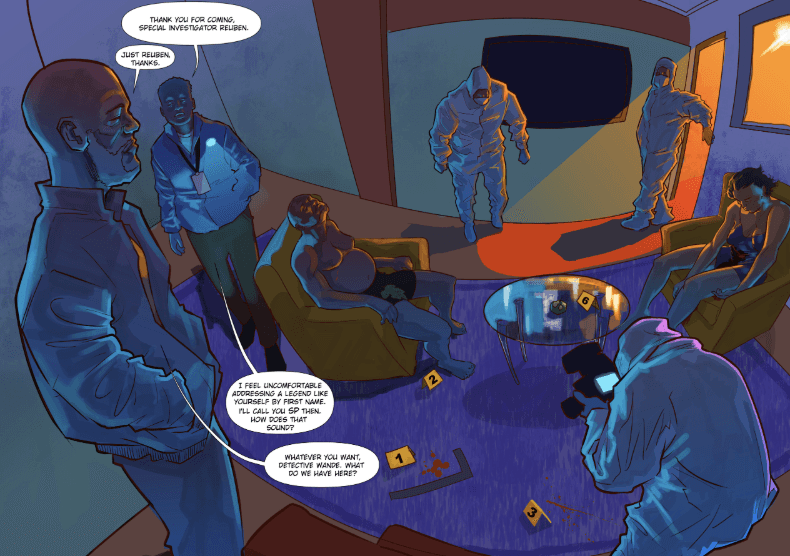
The victims were tranquilised, stripped, and posed to mimic the biblical Fall of Man, complete with fig leaves and the symbolic removal of the husband’s rib, which was then used to kill the wife. As the investigation unfolds, it becomes clear that this is part of a larger pattern. Abiola reveals that the killer is meticulously imitating classic paintings, using "human life as his canvas and paint". The tension is further heightened by Abiola’s own history of substance abuse, leading his colleagues to wonder if he is truly seeing a pattern or if his "perpetual paranoia" is manifesting ghosts where none exist.
The Critical Perspective: Visuals and Pacing
Ifeoluwa’s art style is deeply atmospheric, utilising a heavy, shadowed aesthetic that grounds the story in the "Abuja Noir" tradition. The depiction of the crime scenes is purposefully jarring; the juxtaposition of brutal violence with delicate, "aesthetically pleasing" posing creates a profound sense of unease. The use of colour, or the deliberate lack thereof in certain panels, effectively separates the clinical reality of the investigation from the visceral horror of the killer's "art.
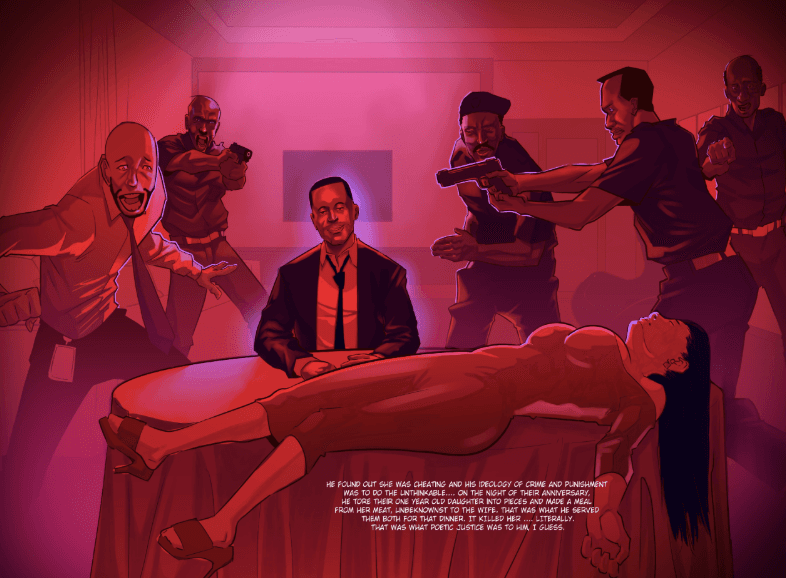
A good and quick reference is on page 3, where we see Abiola immediately reaching for a cigarette while standing over a gruesome scene, framed in a low-angle shot that makes him look both imposing and exhausted. His addiction isn't just mentioned; it is seen in the jittery line-work and the nicotine patch mentioned on Page 10. This visual shorthand tells the reader that Abiola is a man who "sees too much" and needs chemicals to dull the input.
The visual storytelling also excels in its use of symbolic framing. The transition from the clinical description of a "surgical saw" to the theological recitation of Genesis ("And the rib which the Lord God had taken from man...") creates a rhythmic, almost liturgical pace. The sequence on Pages 8 and 9, where the killer's process is described, uses such rhythmic layout, forcing the reader to slow down and absorb the "artistry" of the crime, mimicking the killer's own obsessive focus. Here, Ifeoluwa demonstrates a sophisticated understanding of how to guide the reader's eye through a crime scene, using necessary close-ups to build the mystery piece by piece.
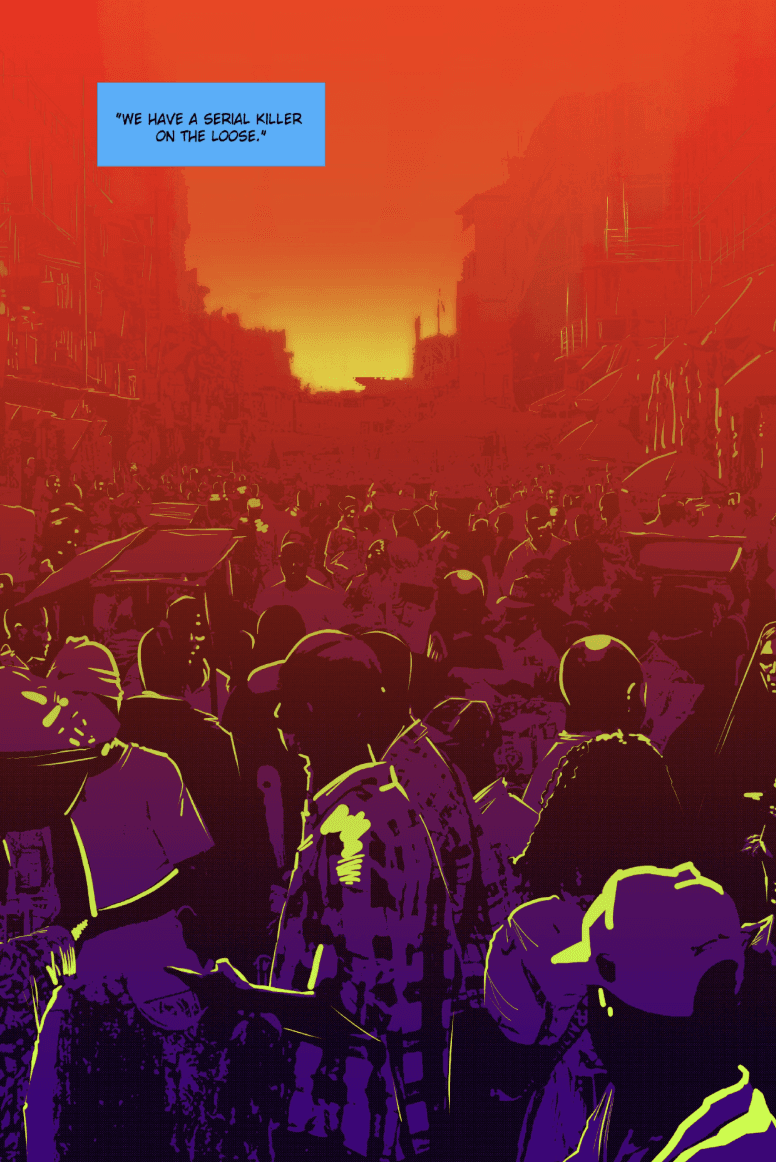
The dialogue is sharp, particularly in the interactions between the veteran Abiola and the younger Detective Wande. There is a "show, don't tell" quality to the writing; we learn of Abiola’s "legendary" status and his struggles with addiction through the whispers of his peers rather than clunky exposition. The script successfully weaves Nigerian cultural nuances, such as references to "Benson" cigarettes and the domestic warmth of "Ewedu" soup, into a story that otherwise feels like a universal psychological thriller.
Room for Refinement
While Hounds and Jackals is a triumph of atmosphere, there are areas where the technical execution could be tightened to match the brilliance of the concept.
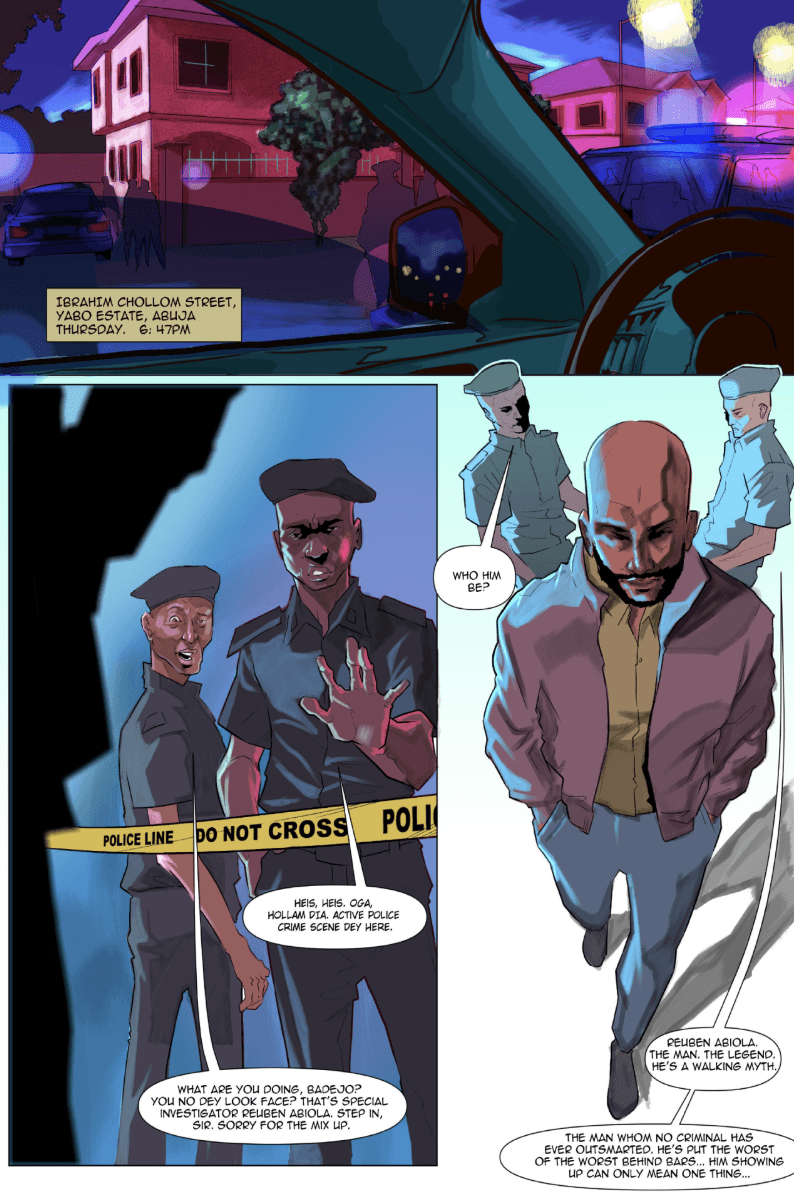
The handwritten style of the lettering, while contributing to the "gritty" aesthetic, occasionally suffers from legibility issues, particularly during the denser exposition scenes on Page 3. In a digital format, where readers often view content on mobile devices, the lack of uniform kerning (the space between letters) can cause eye fatigue. Utilising a slightly more structured, bespoke comic font would maintain the "indie" feel while ensuring the complex dialogue, vital to a procedural, is effortlessly readable.
There are moments where the transition between locations feels somewhat abrupt. For instance, the move from the high-tension crime scene to the domestic setting on Page 10 could benefit from a "bridge" panel, a wide shot of the city or a change in the colour temperature, to signal the shift in tone more clearly. This would prevent the reader from feeling momentarily disoriented by the sudden shift from theological horror to family life.
Our Verdict
Hounds and Jackals is a rare example of an African comic that treats crime, faith, and violence with formal seriousness rather than spectacle. Its strength lies in its unsettling imagery and disciplined visual storytelling. By grounding its horror in the familiar geography of Abuja, the comic resists abstraction and forces the reader to confront evil as something local, intimate, and structurally embedded.
While minor technical refinements in lettering and scene transitions would improve readability, these do little to diminish the work’s overall impact. Hounds and Jackals stand as evidence that African comics can engage complex psychological and philosophical themes without relying on genre excess or mythic distance. It is a confident, unsettling work; one that rewards patience, rereading, and critical attention.
--------------------------------------------------------
--------------------------------------------------------
AI Use at TheACE
TheACE uses artificial intelligence tools to support research, drafting and analysis across Africa’s creative industries. All content is verified, edited and approved by our human editorial team to ensure accuracy, clarity and responsible storytelling. AI assists our work; it does not replace human judgment.