Unmasking the Invisible Giant Beyond the Panels: A Retrospect on the Nigerian Comic Industry Report and the Missing Ink
29 Nov 2025
News

Recent Posts
We Are Moving
14 Feb 2026
Toontopia Festival Returns for Second Edition as Nigeria’s Animation Ecosystem Expands
14 May 2026
Cultural Blind Spot and the Missing Category: Why AMVCA Must Recognise African Animation
13 May 2026
Cairo’s Animatex 2026: A 90-Year Legacy Meets the Cutting Edge of Global Animation
18 Feb 2026
Introducing The10: A Curated List of Women Shaping Africa’s Comic and Animation Future
16 Feb 2026
If you walked through the bustling aisles of the Landmark Centre during the Lagos Comic Con in September 2024, you would have seen an industry alive with colour, noise, and unbridled passion. With over 7,000 attendees and a market valuation hitting USD 31.95 million, the Nigerian comic book space is no longer a hobbyist’s corner; it is a rising economic frontier.
And when the doors opened at the Cyprian Ekwensi Centre for Arts and Culture for the Capital City Comic Convention in Abuja that same year, it wasn't just about superheroes; it was a statement that the industry is expanding far beyond Lagos. From the grassroots energy of Uniben Comic Con in Edo State to the consumer-driven bustle of Geek PopUp in Victoria Island, 2024 proved that the Nigerian comic scene was not a monolith; it is a thriving, nationwide archipelago of creativity.
Yet, despite the rise of titans like Comic Republic and the breakout success of indie hits like Celestial Eyes, a shadow remains over the sector.

In our inaugural Bookause Annual Comic Book Industry Report 2024, we documented this explosion of culture and uncovered a startling truth: nearly 90% of the industry's potential remains hidden from the global stage. While Western and Japanese productions dominate the conversation, African narratives often struggle against a void of data. Investors, policymakers, and international distributors cannot support what they cannot measure. So, to truly map this ecosystem, we must understand the missing ink of the readers who fuel the creators and the studios.
The Hidden Gems and the Data Deficit
The 2024 Report was a landmark achievement, the first detailed examination of its kind. We chronicled the release of over 60 titles in a single year and celebrated the resilience of creators who are bypassing traditional gatekeepers via digital platforms like Webtoon and Global Comix.
While industry heavyweights like Comic Republic secured historic deals with Universal Pictures, the real story of 2024 was often found in the margins, where independent studios pushed the boundaries of storytelling. We saw Etta Studios tackling complex social themes with titles like Hijacked #1 and Moirai #1. We witnessed Symphonii Studios capturing the hearts of the younger demographic with relatable, slice-of-life narratives in Alter Ego and Homecoming.

Innovation wasn’t just in the scripts; it was in the ink itself. We Are Erivic Productions introduced "Afroblot", a cost-effective, ink-splash art style showcased in Jogunomi, proving that economic constraints can breed stylistic brilliance. Meanwhile, Comic Arena’s Fusion: The Awakening garnered over 1,200 local reads, tackling the visceral reality of bullying through a superhero lens.
These are not just comic books; they are cultural artefacts. Yet, despite these creative victories, a significant gap remains.
As we noted in the conclusion of our 2024 report, there was a "reluctance to make numbers public” among many publishers. We know the art is world-class. We know the stories, from the mythology of Amadioha to the noir thrills of Granite Knight, are compelling. We know that The Machine’s Celestial Eyes cracked Global Comix’s top 10 fantasy list, and Raynay Publishing’s Eze sold over 1,000 copies. But still, much of the industry operates in a data vacuum. Without hard data on readership habits, spending power, and demographic preferences, the "Giant of Africa" remains invisible to the global economy.
The Readers Move the Industry
The industry is shifting. We are seeing a move toward digital dominance, with web and mobile platforms projected to account for significant market shares. We are seeing a demographic dividend, with 60% of the population under the age of 25 hungry for content that reflects their reality.
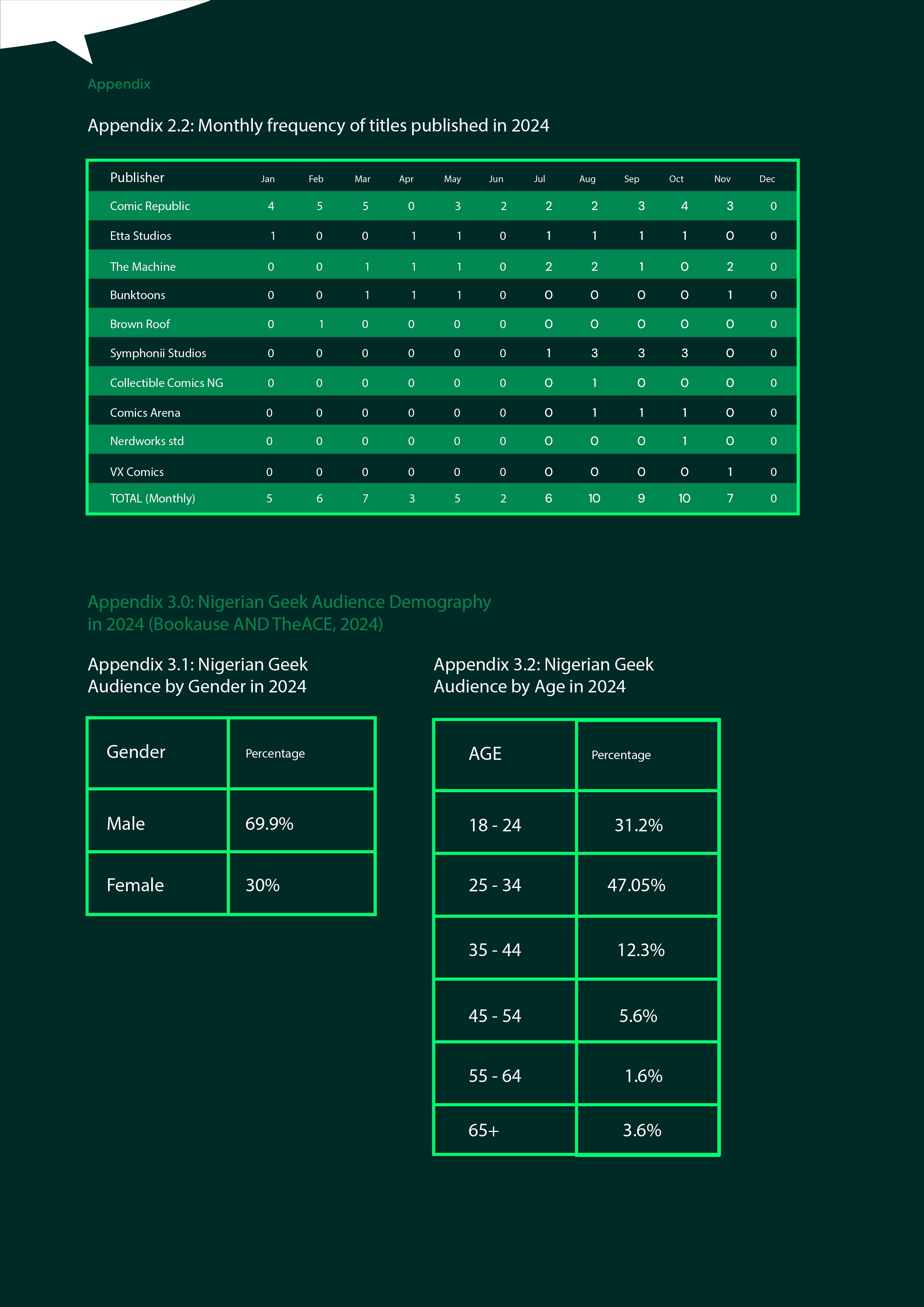
We know the talent exists. We know the studios, from Bunktoons delving into fantasy to Afrikulture Media exploring mythology in Children of Anansi, are producing world-class work. But we do not fully understand the reader. Ergo, to turn these trends into actionable growth strategies for 2025, we need more than observation; we need the comic book reader’s input.
As we work on the Second Edition of the Annual Comic Book Industry Report, we face an urgent need to compile critical data. Sales figures from publishers are not enough; we need to understand the heartbeat of the industry, the reader.
What drives the reader to buy a local comic over a foreign one? Do they prefer the physical feel of a book or the convenience of a webcomic? Which breakout creators of 2024 captured their imagination?
These questions won’t answer themselves. Only comic book readers can.
Be the Catalyst, Let Us Map the Future
The Bookause Annual Comic Book Industry Report is more than a document; it is a tool for convincing investors, policymakers, and global distributors that Nigerian comics are a viable economic force. So, to help build a bridge between the art we love and the business structure it needs to survive, we invite comic book readers to participate in our 2025 Readers Survey.
By sparing five minutes to complete our industry survey, you (the comic book readers) are doing more than ticking boxes; you are advocating for the many emerging creators like Francis Goodluck, Bello Richard, and Emmanuel Udofia, ensuring their work finds the audience and the funding it deserves. You are also providing the ammunition needed to attract foreign investment, justify government grants, and help creators like The Machine or Symphonii Studios understand exactly what you want to read next.
The 2024 report proved that we have an industry worth celebrating. Your reading habits are the data points that will define 2025. Let’s write this next chapter together. Help us make the 2025 report the tool that takes the industry to the world. Take the survey now.
…………………………………………………………….
…………………………………………………………….
AI Use at TheACE
TheACE uses artificial intelligence tools to support research, drafting and analysis across Africa’s creative industries. All content is verified, edited and approved by our human editorial team to ensure accuracy, clarity and responsible storytelling. AI assists our work; it does not replace human judgment.