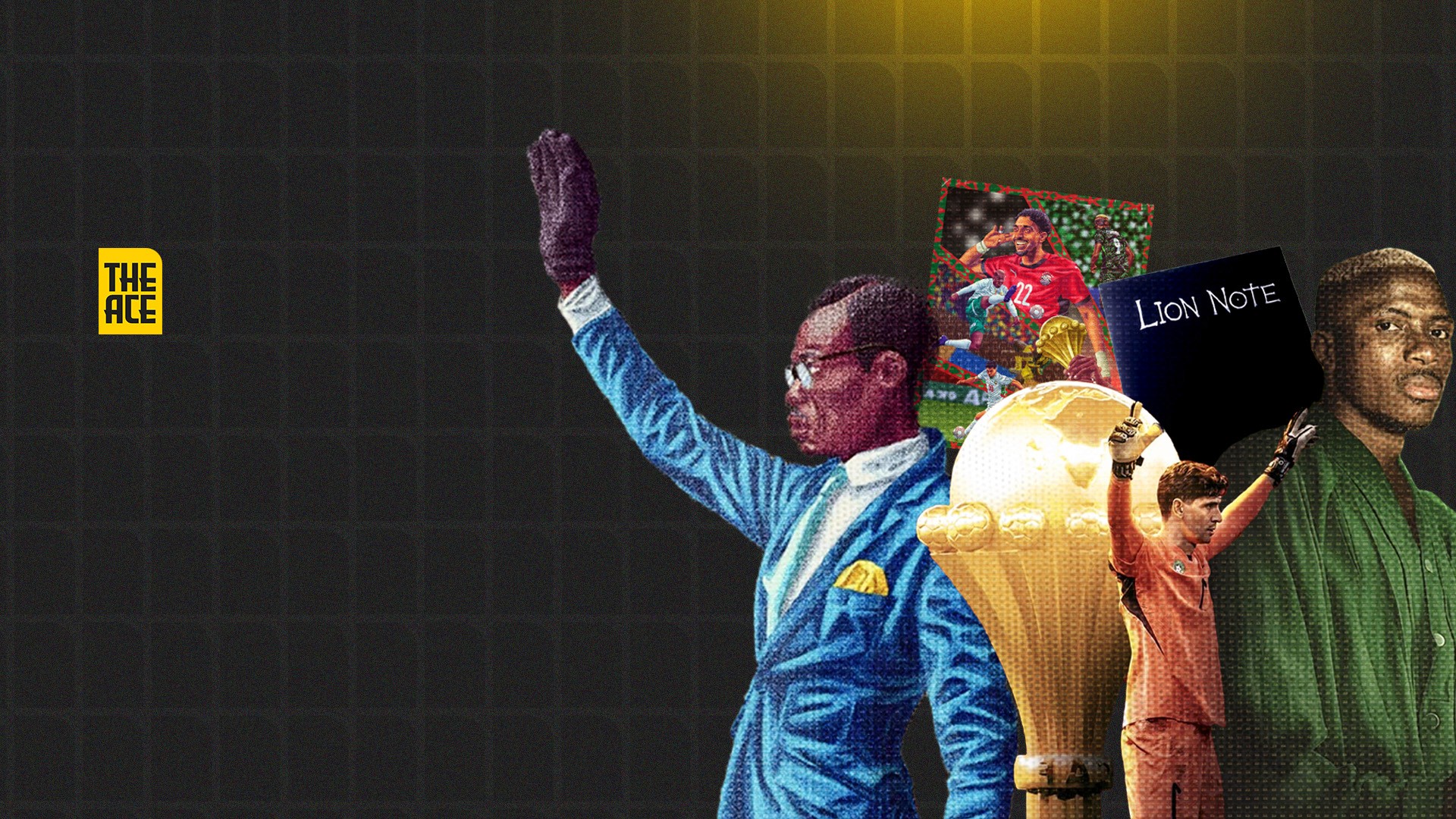
When Football Became Sequential Art: How AFCON 2025 Became a Living Comic Archive Beyond the Scoreline
26 Jan 2026
Feature
Recent Posts
We Are Moving
14 Feb 2026
Toontopia Festival Returns for Second Edition as Nigeria’s Animation Ecosystem Expands
14 May 2026
Cultural Blind Spot and the Missing Category: Why AMVCA Must Recognise African Animation
13 May 2026
Cairo’s Animatex 2026: A 90-Year Legacy Meets the Cutting Edge of Global Animation
18 Feb 2026
Introducing The10: A Curated List of Women Shaping Africa’s Comic and Animation Future
16 Feb 2026
AFCON 2025 in Morocco will be remembered for its numbers. Packed stadiums. Record-breaking commercial returns. A tournament watched across continents, with fans flying in from Europe, North Africa, and beyond. The semi-final in Rabat alone drew over sixty thousand spectators into the Prince Moulay Abdellah Stadium, a moment that captured just how magnetising the tournament had become.
But while AFCON 2025 was being measured in attendance figures and broadcast reach, it was also unfolding in another register entirely.
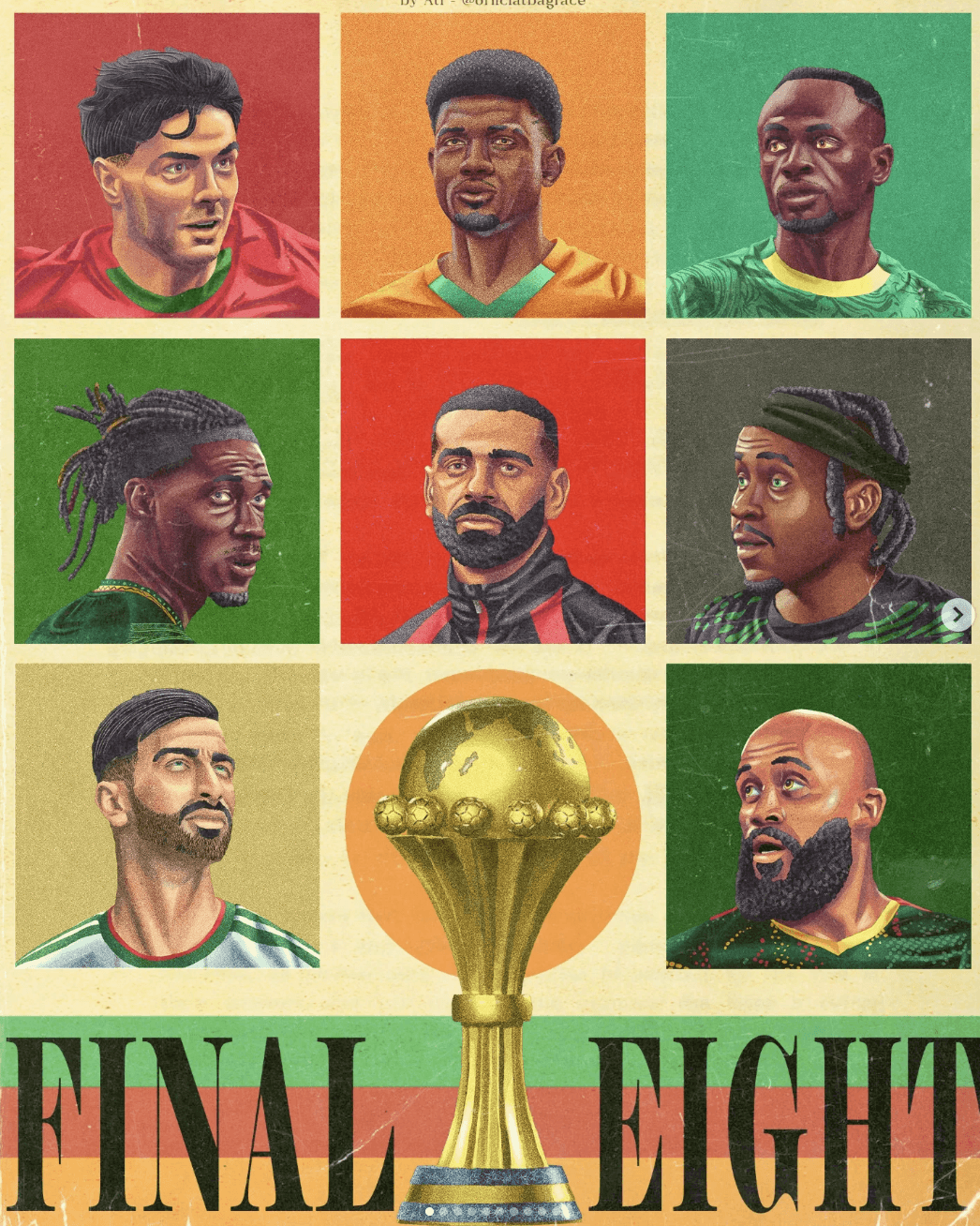
Away from match reports and television graphics, the tournament began to appear in drawn form; through illustrations, comic-like framing, exaggerated gestures, and symbolic composition. Creatives responded not by replaying goals, but by translating emotion, pressure, and collective memory into visual narratives. Football was no longer just being watched. It was being interpreted.
This was not an organised movement or a branded initiative. It happened instinctively. As the tournament progressed, artists reached for the visual language they knew best; comics, illustration, graphic storytelling, to slow the game down and make sense of it.
One of the clearest expressions of this instinct came from Nigerian illustrator Chinonso Wilfred. While AFCON 2025 was still ongoing, Chinonso began releasing pages of a comic documenting the Super Eagles’ journey through the tournament. Matches became emotional beats. Wins and losses carried psychological weight. The team was not framed as invincible heroes, but as human figures navigating expectation, scrutiny, and national hope.
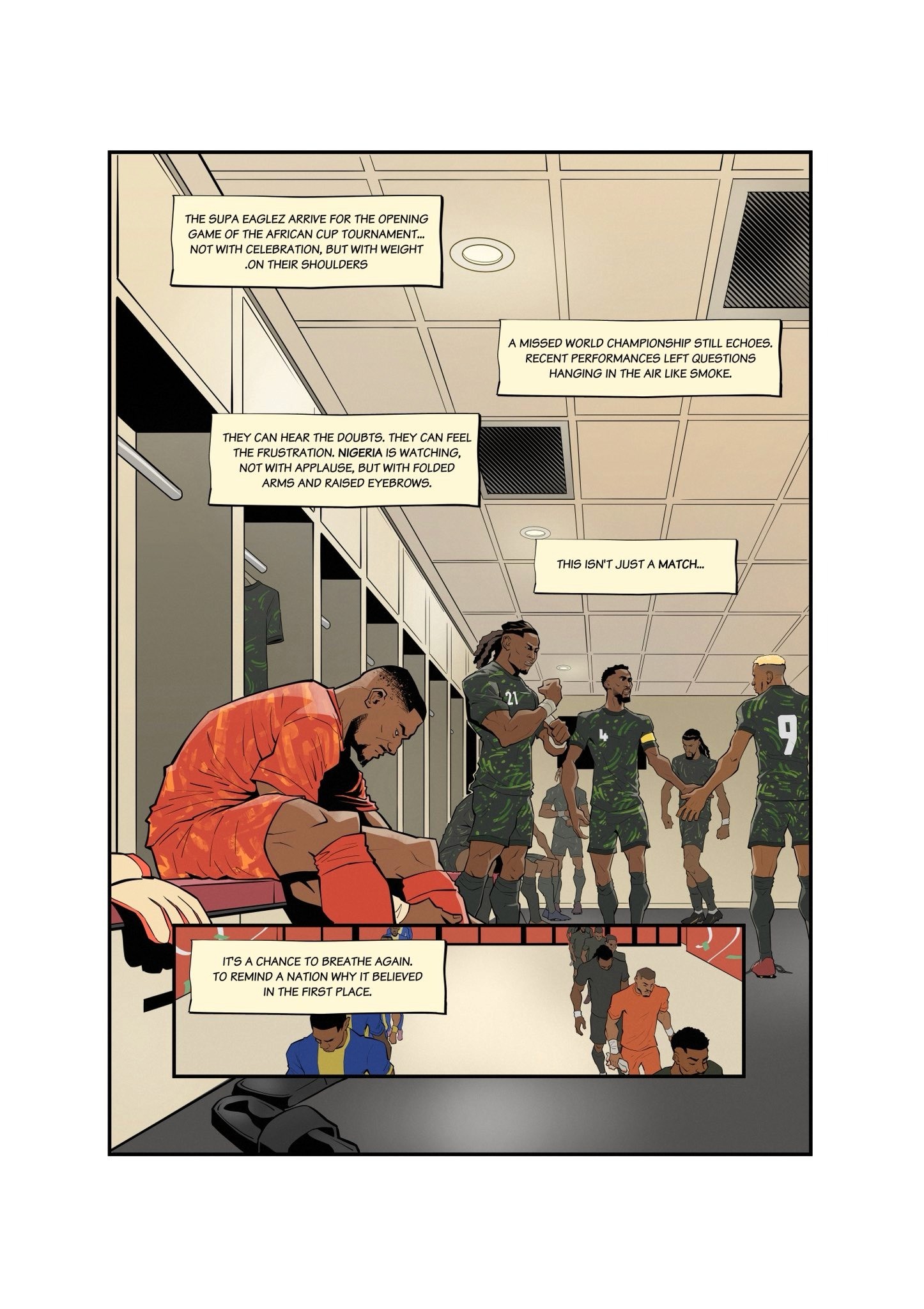
Reflecting on the project, Chinonso described it as an attempt to capture what numbers never could; the passion, pressure, and emotional demand placed on Nigerian footballers by a nation that lives and breathes the game. “This is the kind of story statistics can’t explain,” he noted, positioning the comic not merely as art, but as a form of visual memory, something future readers could feel, not just analyse.
In this sense, the comic functioned as an alternative archive of AFCON 2025, one rooted in lived experience rather than data.
Elsewhere, similar impulses surfaced in different visual forms.
Maghreb-based illustrator Karim Moutaqi responded to AFCON 2025 with striking, cinematic illustrations that leaned into comic-adjacent sensibilities. His work froze footballers in moments of tension and release, using dramatic framing and motion to suggest narrative continuity even within single images. It felt fitting that these interpretations emerged from the host region itself, where stadiums were filled to capacity and the atmosphere around matches carried a particular intensity. When tens of thousands gathered in Rabat and Casablanca, the spectacle on the pitch demanded an equally dramatic visual response off it.
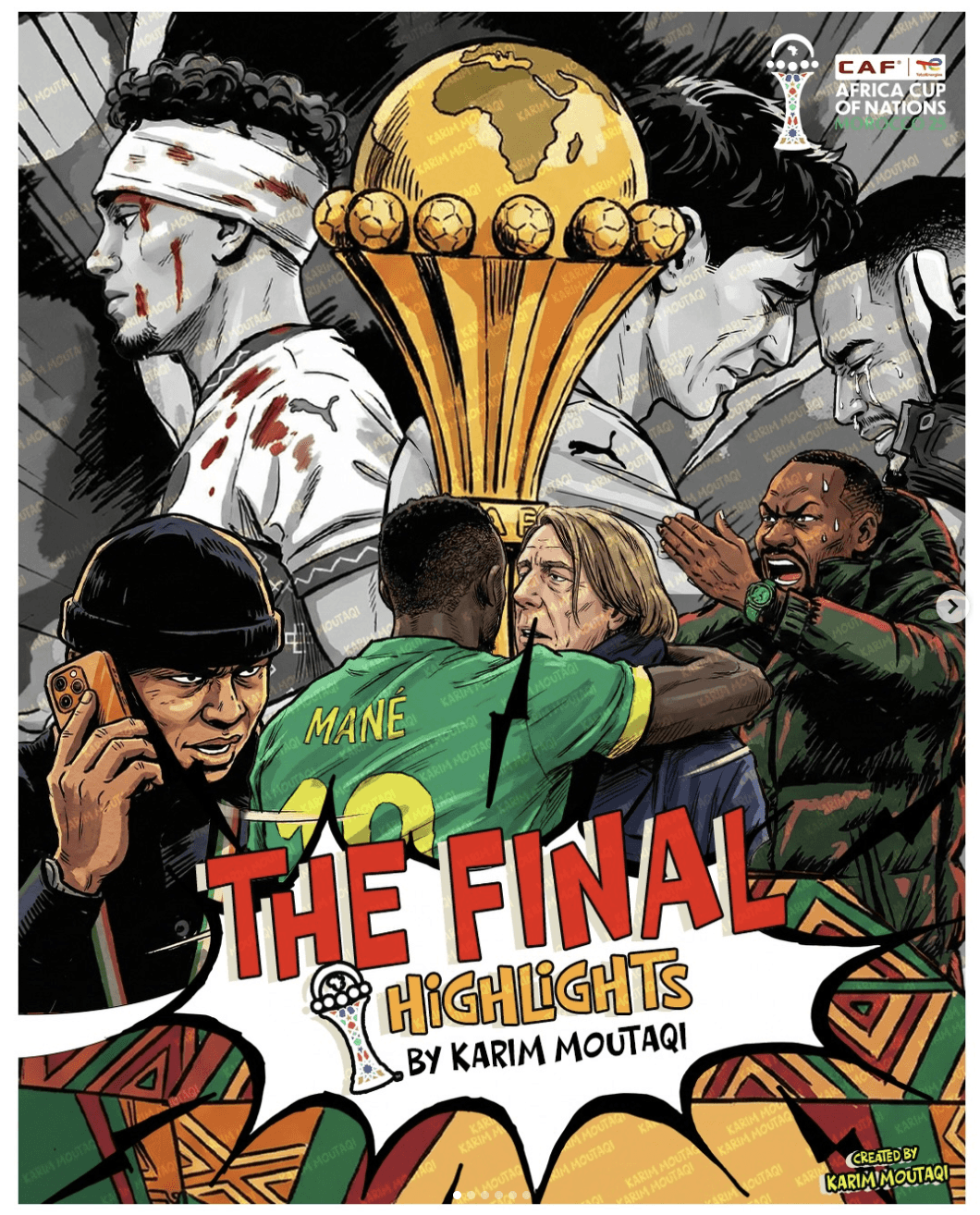
Moutaqi’s illustrations did not document matches play by play; they distilled them. Each piece felt like a panel extracted from a larger, invisible sequence; football as myth, football as moment.
The tournament’s visual afterlife also extended beyond the continent. AFCON 2025 attracted significant attendance from the African diaspora, particularly from Europe, with France accounting for a substantial share of international ticket sales. That outward pull was mirrored in the creative responses it inspired.
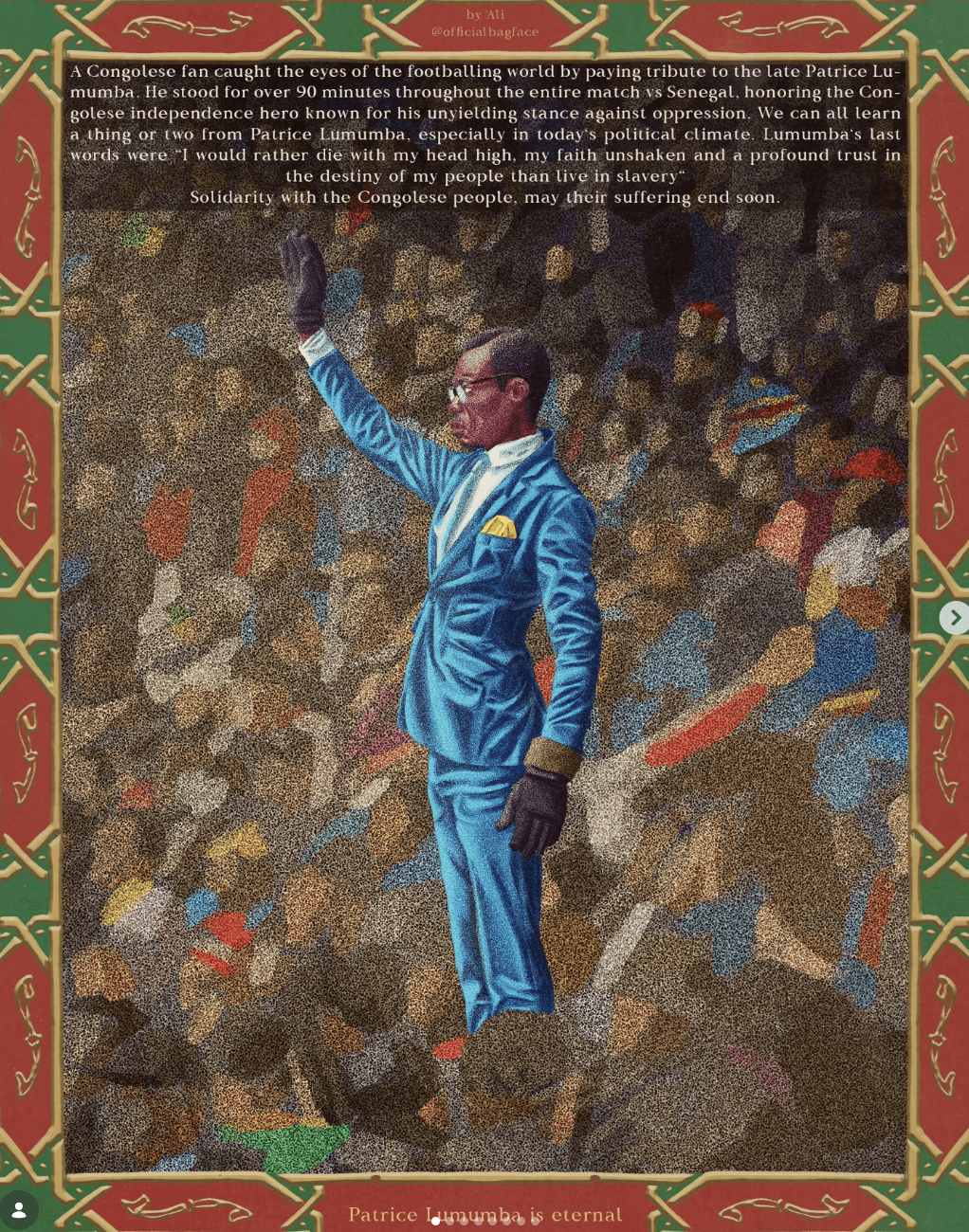
Illustrations by Ali, popularly known as Bagface, circulated widely during the tournament, blending satire, exaggeration, and cultural shorthand. Though Beirut-based, his work demonstrated how AFCON’s emotional cues resonated far beyond Africa’s borders. African football became a shared visual language; instantly readable, remixable, and culturally legible to creatives operating outside the continent but deeply plugged into global pop culture.
Even designers working outside traditional comic structures felt the same pull. MAG8, also known as Moustafa Designs, produced graphic interpretations of AFCON 2025 moments that compressed entire matches into symbolic compositions. While not comics in structure, the work relied on narrative instinct; an urge to frame the tournament as a sequence of meaningful moments rather than a continuous stream of action.
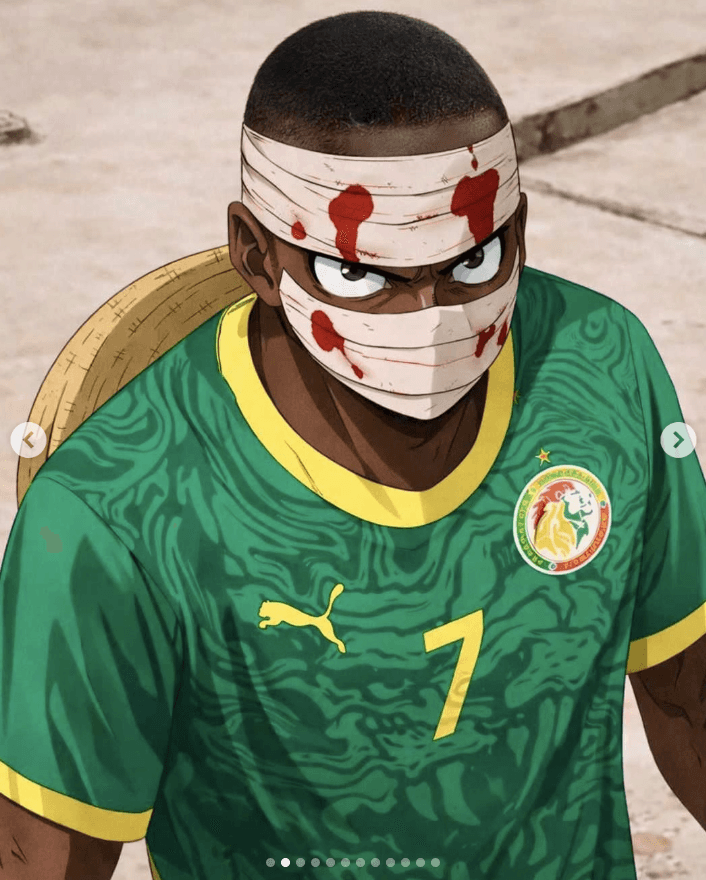
Perhaps most revealing was a moment highlighted by Versus: a Senegalese player, Habib Diara, openly referencing anime as a framework for documenting his personal AFCON journey. Here, visual storytelling was not an external response to football, but an internalised lens, proof of how deeply narrative art has shaped how contemporary athletes process experience.
Taken together, these examples reveal that AFCON 2025 was not only played and watched; it was quietly narrated. Comics, illustration, and graphic design became tools for meaning-making, ways of capturing what slips through official summaries.
Despite the pan-African reach of AFCON 2025, much of the viral comic-like visual documentation has so far appeared in West and North African feeds, hinting at emerging but uneven creative engagement across Africa’s regions. That imbalance is not a weakness of the story, but part of its significance. It points to an opportunity, one where future tournaments may see more intentional visual chronicling across Southern, Eastern, and Central Africa.
AFCON 2025 reminds us that football history is not preserved by numbers alone. Sometimes, it is drawn, panel by panel, image by image, by creatives who understand that some moments are too human to be reduced to statistics. In that sense, AFCON 2025 did not just happen, it was illustrated into memory.
Written by: Mujeeb Jummah
Edited by: Seyi Adedokun
Sources: Hespress, The Star, MoroccoBeat, African Folder, and Versus
--------------------------------------------------------
--------------------------------------------------------
AI Use at TheACE
TheACE uses artificial intelligence tools to support research, drafting and analysis across Africa’s creative industries. All content is verified, edited and approved by our human editorial team to ensure accuracy, clarity and responsible storytelling. AI assists our work; it does not replace human judgment.